

Study Abroad
Spanish
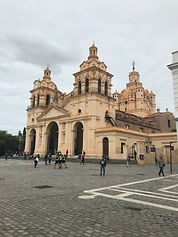
Through my Language and International Trade - Spanish major I had the opportunity to study abroad for five months in Córdoba, Argentina in my sophomore year (Spring 2019). While there, I took classes in Spanish language, Argentinian literature, Latin American history, culture, and international business. I also completed an internship with the company la Cámara de Industrias Informáticas, Electrónicas y de Comunicaciones del Centro de Argentina (CIIECCA). My time spent in school, working, and with my host family truly gave me the full immersive experience into the culture and helped me to further develop my language skills.
One of the most exciting parts of being abroad were the opportunities for travel. My fellow students and I explored various places in Córdoba, Buenos Aires, and even other sites throughout Argentina - such as Iguazu Falls and Jujuy. We also left the country a few times through some overnight buses, short flights, and a ferry to go to Uruguay, Chile, and Brazil. I even went into Paraguay alone to explore for a day. Overall, the experiences we had and the people we met helped us to create strong friendships and experience deep personal growth, while also improving our Spanish language skills by leaps and bounds.
Moving to Argentina for five months after having lived in the United States for all of my life was definitely a culture shock at first. Some things were the same, like my friends and I would hang out at the mall together after school and study at local coffee shops. Other aspects of life abroad were very different. The food was entirely different from what I was used to and what I had expected, but I came to really love cheese and tomato empanadas and medialunas con miel (honey croissants). I also had to learn the public transportation system, which was a big difference for me. Having grown up in a rural community, I had never relied on buses to get around, but quickly learned the schedule (and to be early to the bus stop if I really needed to be somewhere on time). Perhaps the biggest cultural surprise to me, however, was that being on time in most situations was actually not that big of a deal. The culture was so much more relaxed than that in the U.S., and punctuality and other stuffier aspects of professionalism often fell by the wayside in favor of building positive social relationships and maintaining a relaxed, optimistic environment. The friendliness of the people - whether we were making our way through a boliche, hanging out on campus, or passing around a cup of mate - created such an amazing, welcoming atmosphere.


Chinese
After having such a great experience abroad in Córdoba, I was really looking forward to solidifying my Chinese language skills through the CU in China program that Clemson holds in the summer. Sadly, the program was cancelled due to the Covid-19 global pandemic, but I will still take the language and culture classes for the program over the summer (2021) in Clemson, South Carolina. However, I do have prior experience in China, and I have taken many Chinese culture and history classes in Clemson so far.
I was able to visit China in both 2005 and 2009 because both of my younger siblings were adopted from the Hunan province. I was a young child during both trips, but I still managed to learn a lot about the different dynasties in China's history and then the governments that followed. I was also able to see monuments/historical locations, such as the Great Wall and Tiananmen Square. It was an amazing experience to visit Beijing, Changsha, and Guangzhou and meet so many kind people who were excited to share their country and culture with my family. I credit these experiences with inspiring me to pursue Chinese language study in college.
In Clemson, I began my language study my freshman year with Elementary Chinese classes. It is a pretty difficult language to learn, and I definitely faced some struggles. By the time I got to my junior year though, some of the grammar points were starting to click. I began to take cultural classes too, like Buddhism in China, Philosophy of Ancient China, Philosophy of Modern China, and History of Modern China. Professor An taught three of those classes and gave us a ton of knowledge about Confucius, Mencius, Zhuangzi, and other important philosophers. I learned about the teachings that set the foundation for China's society, and it helped me to better understand the cultural importance of family and moral models. My Pre-Modern Chinese literature class was especially interesting, particularly the section on ghost stories. I was fascinated to read the literature and then learn the historical context behind the stories. My world archaeology class gave me insight into the ancient basis of Chinese civilization, including the importance of oracle bones used for divination to shape decision making for the people in early China. All of this knowledge gained during my time in Clemson has fostered an ongoing passion for learning about Chinese language, history, and culture that I hope to continue through my studies this Summer.
One aspect of the culture that I have experienced both in China and through Chinese cultural events in the United Sates, is the cuisine. While in China, I had some of the spiciest food that I had ever tasted. It was cooked in the Sichuan style, which is famed for its use of spice. The most interesting thing though was the extreme variance in foods depending on the region, with each area of the country having unique flavors and dishes. I also visited a tea house for the first time ever during that trip, which was such an enriching experienced that broadened my horizons. Coffee is definitely more popular in the United States, so as a kid, I did not know the sheer number of tea options available until going to China. The teas were also far richer than the highly processed English Breakfast tea bags that I had had previously in the United States. At Clemson, I celebrated the Mid Autumn Festival with the Chinese Language Club. We shared moon cakes filled with red bean paste, sticky buns, and other foods that were more authentic than the standard Americanized Chinese takeout. I enjoyed what I could eat, but it is honestly a bit difficult to find authentic foods that I can eat as a vegetarian that are not cooked with any sort of meat or animal fats. I do feel that vegetarian and vegan food are more widely available in the U.S., but China does have its fair share of vegetable/soy-based dishes, such as Chinese broccoli and tofu. Cuisine is a big part of culture, and overall, it is very interesting to see how the different cuisines of China represent the various diverse regions around the country.
Another cultural factor that I have experienced/learned about is medicine. China currently has options for patients to pursue both traditional and modern medical treatment. The traditional medicine can include healing strategies such as herbal remedies and acupuncture. People who specialize in this may have been more holistically trained. Whereas, the modern medicine employs the latest antibiotics and technologies available to the treatment center to deal with various ailments, and the practitioners are normally nurses and doctors who followed a set curriculum to become certified. This is an interesting topic to compare to the United States because while the U.S. currently tends to lean more into modern medicine, the Native American communities have their own traditional remedies that are similar in some ways to the ancient Chinese methods that persist in today's traditional medical practices. There also "at home remedies" that a lot of people in the United States use to solve issues without going into the doctor and even holistic medical practices that operate under specific guidelines, but these have much less of a traditional basis than the ones in China or they pull from the traditional practices of other cultures. This goes to show the significance and continuity of traditional practices in China and how methods from thousands of years ago have persisted.